
Note: Website is under construction right now & content is not accurate. Please wait for few days.
_edited.png)
About LASIK Eye Treatment

LASIK (Laser-Assisted In Situ Keratomileusis), commonly known as laser eye surgery or laser vision correction, is a type of refractive surgery used to correct common vision problems such as myopia (nearsightedness), hyperopia (farsightedness), and astigmatism.
The procedure reshapes the cornea so that light focuses properly on the retina, improving overall vision clarity.
At IMG Healthcare, we provide access to advanced LASIK technology designed to deliver safe, precise, and effective vision correction. The procedure is quick, minimally invasive, and typically painless, helping eligible patients reduce or eliminate their dependence on glasses or contact lenses.
What is LASIK Eye Surgery?

LASIK (Laser-Assisted In Situ Keratomileusis) is a widely performed laser eye surgery used to correct common vision problems such as myopia (nearsightedness), hyperopia (farsightedness), and astigmatism. The procedure is performed by a qualified ophthalmologist, who uses advanced laser technology to reshape the cornea, allowing light to focus properly on the retina and improving visual clarity.
For many people, LASIK offers a long-lasting alternative to glasses or contact lenses. The procedure is quick, minimally invasive, and typically involves little discomfort, with most patients experiencing improved vision within a short time after surgery.
LASIK is one of several refractive surgery options available. Depending on factors such as corneal thickness, prescription, and overall eye health, an eye specialist may recommend LASIK or another suitable vision correction procedure after a comprehensive evaluation.
Why is LASIK done?
LASIK is performed to correct refractive errors—common vision problems that occur when the eye cannot focus light accurately onto the retina. These errors are usually caused by changes in the shape of the cornea or the length of the eyeball, resulting in blurred vision.
Refractive errors may develop due to:
-
An eyeball that is too long or too short
-
An irregularly shaped cornea
-
Age-related changes that affect the eye’s ability to focus light
LASIK surgery reshapes the cornea using advanced laser technology, helping light focus correctly on the retina and improving vision. It is commonly used to treat the following conditions:
Myopia (Nearsightedness)
In myopia, the eyeball is too long or the cornea is too curved, causing light to focus in front of the retina. As a result, distant objects appear blurry while nearby objects remain clear.
Hyperopia (Farsightedness)
In hyperopia, the eyeball is too short or the cornea is too flat, causing light to focus behind the retina. This makes nearby objects appear blurry and may also affect distance vision in some cases.
Astigmatism
Astigmatism occurs when the cornea has an uneven shape, preventing light from focusing evenly on the retina. This can cause blurred or distorted vision at all distances.
By precisely reshaping the cornea, LASIK can effectively correct these refractive errors and reduce or eliminate the need for glasses or contact lenses in suitable candidates.

Types of Refractive Errors
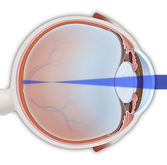
Myopia

Hyperopia

Astigmatism
Common Causes of Refractive Errors
Symptoms of Refractive Errors
-
Short or Long Eyeball
-
Irregularly Curved or Flattened Cornea
-
Age-Related Changes in the Eye Lens
-
Corneal Inflammation
-
Eye Injury
-
Blurred or Blurry Vision
-
Double Vision
-
Frequent Headaches
-
Glare or Halos Around Lights
-
Eye Strain and Squinting
-
Difficulty Seeing Nearby Objects, Distant Objects, or Both
Diagnosis of Refractive Errors
-
Comprehensive Eye Examination
A comprehensive eye examination includes visual acuity and refraction tests, along with other assessments to evaluate overall eye health and diagnose refractive errors.
-
Refraction Test
A refraction test evaluates how light is focused by the eyes to detect refractive errors such as myopia, hyperopia, and astigmatism. It helps the eye specialist determine the correct prescription for glasses or contact lenses and assess the need for vision correction.
-
Visual Acuity Test
A visual acuity test measures your ability to see letters, symbols, or objects clearly at a specific distance. It helps evaluate the sharpness and clarity of your vision and may also assess aspects such as color vision, peripheral vision, and depth perception. Common methods include the Snellen chart and the Random “E” test.
-
In Snellen, the doctor uses a chart of letters or symbols in which letters are arranged in different sizes in rows and columns.
-
In the random E test, the doctor asks the patient to identify the direction of the letter.
The results of both these tests combined help the doctor to calculate the refractive error which will be used during the surgery.
-
Pachymetry Test
A pachymetry test measures the thickness of the cornea. It helps the eye specialist determine whether the cornea is suitable for LASIK surgery and ensures that enough corneal tissue remains after the procedure for safe and effective vision correction.
-
Corneal Topography
Corneal topography is a non-invasive imaging test that creates a detailed 3D map of the cornea. It helps the eye specialist evaluate the shape and curvature of the cornea and plan LASIK treatment with greater precision and accuracy.
How to Prevent Refractive Errors


The eyes are a very important part of our body, and their health matters a lot when it comes to seeing the world around us. What most people don’t realize is that many vision problems can be avoided and eye health can be maintained by following the steps below:
-
Focus on maintaining your blood sugar levels. High blood sugar levels can significantly increase blood pressure and may affect the optic nerve, which can impair your vision.
-
Know your family’s eye health history to determine if you are potentially at risk of developing certain eye diseases. Refractive errors can be hereditary; that is, if your parents had some type of refractive error, you are more likely to develop it at a young age.
-
Eat healthy foods to protect your eyesight. You may have heard that carrots, green leafy vegetables, fruits, and other nutritious foods are good for your eyes. This is true, as many of these foods are rich in omega-3 fatty acids and other nutrients that support eye health.
-
Wear protective eyewear while playing sports or participating in activities where there is a risk of eye injury. If your eyes are injured, your vision may be affected.
-
Quit smoking, as it is harmful to your overall health as well as your eyes. It can damage the optic nerve and ultimately impair your vision.
-
Go for regular eye check-ups to ensure that vision problems are detected at an early stage. This helps in receiving proper treatment and preventing the condition from progressing.
-
Give your eyes proper rest if you spend the entire day looking at a computer screen. Take regular breaks throughout the day and practice eye exercises to help keep the ciliary muscles healthy.
OUR LASIK SURGERY SPECIALISTS DOCTORS
Dr. ABCD
MBBS,
10 yrs of experience
Dr. ABCD
MBBS,
10 yrs of experience
Dr. ABCD
MBBS,
10 yrs of experience
Types of LASIK Eye Surgery
Several advanced laser vision correction procedures are available to treat refractive errors. The most common types include:
IntraLASIK (Blade-Free LASIK)
In IntraLASIK, the surgeon uses a femtosecond laser to create a thin corneal flap before reshaping the cornea with an excimer laser. This technique offers high precision and quick visual recovery.
PRK (Photorefractive Keratectomy)
PRK is often recommended for patients with thin corneas or those who may not be suitable candidates for LASIK. During the procedure, the outer layer of the cornea is gently removed, and the underlying corneal tissue is reshaped using a laser. The surface layer naturally regenerates during the healing process.
Topography-Guided LASIK (Contoura Vision)
This advanced procedure uses detailed corneal mapping to identify thousands of unique points on the eye’s surface. An excimer laser then corrects these irregularities, providing highly personalized vision correction and potentially improved visual outcomes.
Implantable Collamer Lens (ICL)
For patients who are not eligible for LASIK, an Implantable Collamer Lens (ICL) may be recommended. In this procedure, a specially designed lens is implanted inside the eye to correct vision without permanently altering the cornea.
